

There has been petroleum activity in the North Sea since 1965. The Norwegian Sea and the Barents Sea (areas north of the 62nd parallel) were opened for petroleum activities in 1980. The remaining resources and distribution between discovered and undiscovered resources in opened and unopened areas, respectively, therefore differ between the three ocean areas.
Remaining petroleum resources by sea area as per 31 Dec. 2025
Distribution of remaining liquids resources (green) and gas resources (red) by sea area and resource class (Source: Norwegian Offshore Directorate)
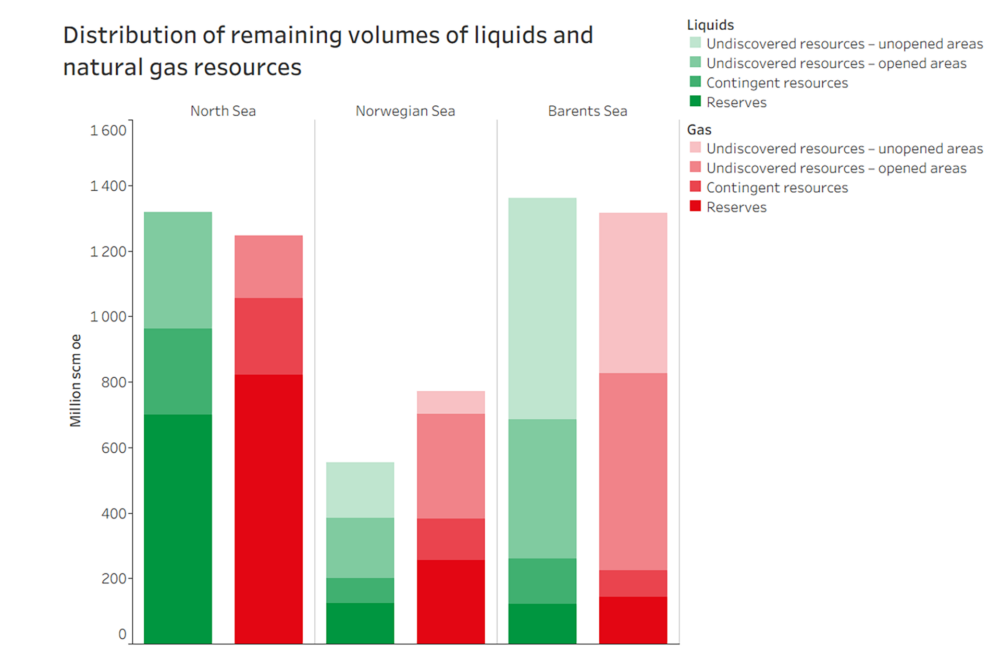
In the North Sea, most of the oil and gas is classified as reserves, which means that they have approved plans for production. In the Barents Sea, most of the oil and gas resources have the status of undiscovered resources. Vast areas in the Barents Sea have not been opened for petroleum activity as yet, and this is where we find the greatest expected value for undiscovered resources.
Undiscovered resources are volumes of petroleum that we assume could be recovered from deposits that have yet to be proven through drilling. The estimates for undiscovered resources in areas opened for petroleum activities are updated on an annual basis. The update is based on assessments taking into consideration the previous year's exploration results, new studies, as well as relevant information from the companies.
In areas that have not been opened for petroleum activities, the estimates are only updated if new data has been acquired in the area, providing significant new information.
Undiscovered petroleum resources in the sea areas
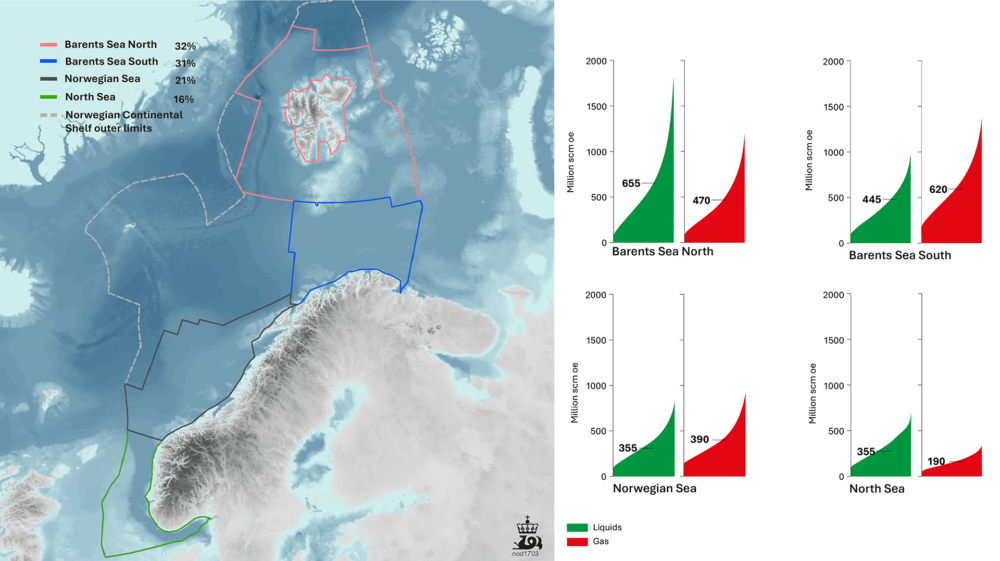
Distribution of undiscovered liquids (green) and gas (red) in the various sea areas, with range of uncertainty (Source: Norwegian Offshore Directorate)
The North Sea is the powerhouse of the Norwegian petroleum activities, with 69 producing fields at year-end. Eleven new discoveries were made in the North Sea in 2025. The largest discovery in the North Sea proven in 2005 is 35/21 (Peon).
The resource accounts for the North Sea show that 175 million Sm³ (MSm³) of oil equivalents (o.e.) were sold and delivered from this part of the Norwegian continental shelf over the past year. At year-end, the reserves amounted to 1522 MSm³ of o.e. The estimate for undiscovered resources in the North Sea is 545 million Sm³ of recoverable o.e. This is distributed between 355 MSm³ of oil and 190 GSm³ of gas.
Even if one cannot rule out that larger discoveries could be made in the North Sea, we expect that the majority of discoveries will be relatively small. The average discovery size in the North Sea over the last five years is 3.5 MSm³ of recoverable o.e.
Total recoverable petroleum resources in the North Sea as of 31.12.2025
Oil and condensate are listed in million standard cubic metres (Sm³). NGL is listed in million tonnes, and gas is listed in billion standard cubic metres. The conversion factor for NGL in tonnes to Sm³ is 1.9. Total oil equivalents are loisted in million Sm³ o.e., 1000 Sm³ gas = 1 Sm³ o.e.
Source: Norwegian Offshore Directorate
Print table Download data Total recoverable petroleum resources in the North Sea as of 31.12.2025
There are 25 producing fields in the Norwegian Sea. Five new discoveries were made in the Norwegian Sea in 2025. The largest discovery in the Norwegian Sea proven in 2005 is 6406/91 Linnorm.
The resource accounts for the Norwegian Sea show that 55 MSm³ of o.e. were sold and delivered from this part of the Norwegian shelf over the past year. At year-end, the reserves amounted to 379 MSm³ of o.e. The estimate for undiscovered resources in the Norwegian Sea is 760 MSm³ of recoverable o.e. This is distributed between 355 MSm³ of oil and 390 GSm³ of gas.
The average discovery size in the Norwegian Sea has increased over the past five years and is now about 4.5 MSm³ of recoverable o.e. The resource estimates for the Norwegian Sea also include the unchanged resource volumes in Lofoten-Vesterålen and in the area around Jan Mayen. These make up approximately 33 per cent of the total estimates.
Total recoverable petroleum resources in the Norwegian Sea as of 31.12.2025
Oil and condensate are listed in million standard cubic metres (Sm³). NGL is listed in million tonnes, and gas is listed in billion standard cubic metres. The conversion factor for NGL in tonnes to Sm³ is 1.9. Total oil equivalents are listed in million Sm³ o.e., 1000 Sm³ gas = 1 Sm³ o.e.
Source: Norwegian Offshore Directorate
Print table Download data Total recoverable petroleum resources in the Norwegian Sea as of 31.12.2025
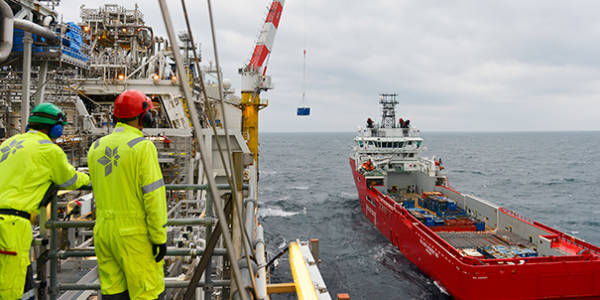
There are three producing fields in the Barents Sea. Five discoveries were made in this sea area in 2025. The largest discovery in the Barents Sea proven in 2013, is 7324/8-1 (Wisting).
The resource accounts for the Barents Sea show that 13 MSm³ of o.e. were sold and delivered from this part of the Norwegian shelf over the past year. At year-end, the reserves amounted to 264 MSm³ of o.e. The estimate for undiscovered resources in the Barents Sea is 2190 MSm³ of recoverable o.e. This is distributed between 1100 MSm³ of oil and 1090 GSm³ of gas. Exploration in the Barents Sea over the past five years has given mixed results. Exploration close to infrastructure has given good results, while wells in new areas were less successful. The average discovery size in this period is about 4.3 MSm³ o.e.
In the Barents Sea, 54 per cent of the resources are located in areas that have not been opened for petroleum activities, primarily in the Barents Sea North. This is the area with the greatest likelihood of making major discoveries on the Norwegian shelf. There are considerable uncertainties associated with the estimates in these areas.
Total recoverable petroleum resources in the Barents Sea as of 31.12.2025
Oil and condensate are listed in million standard cubic metres (Sm³). NGL is listed in million tonnes, and gas is listed in billion standard cubic metres. The conversion factor for NGL in tonnes to Sm³ is 1.9. Total oil equivalents are listed in million Sm³ o.e., 1000 Sm³ gas = 1 Sm³ o.e.
Source: Norwegian Offshore Directorate
Print table Download data Total recoverable petroleum resources in the Barents Sea as of 31.12.2025