

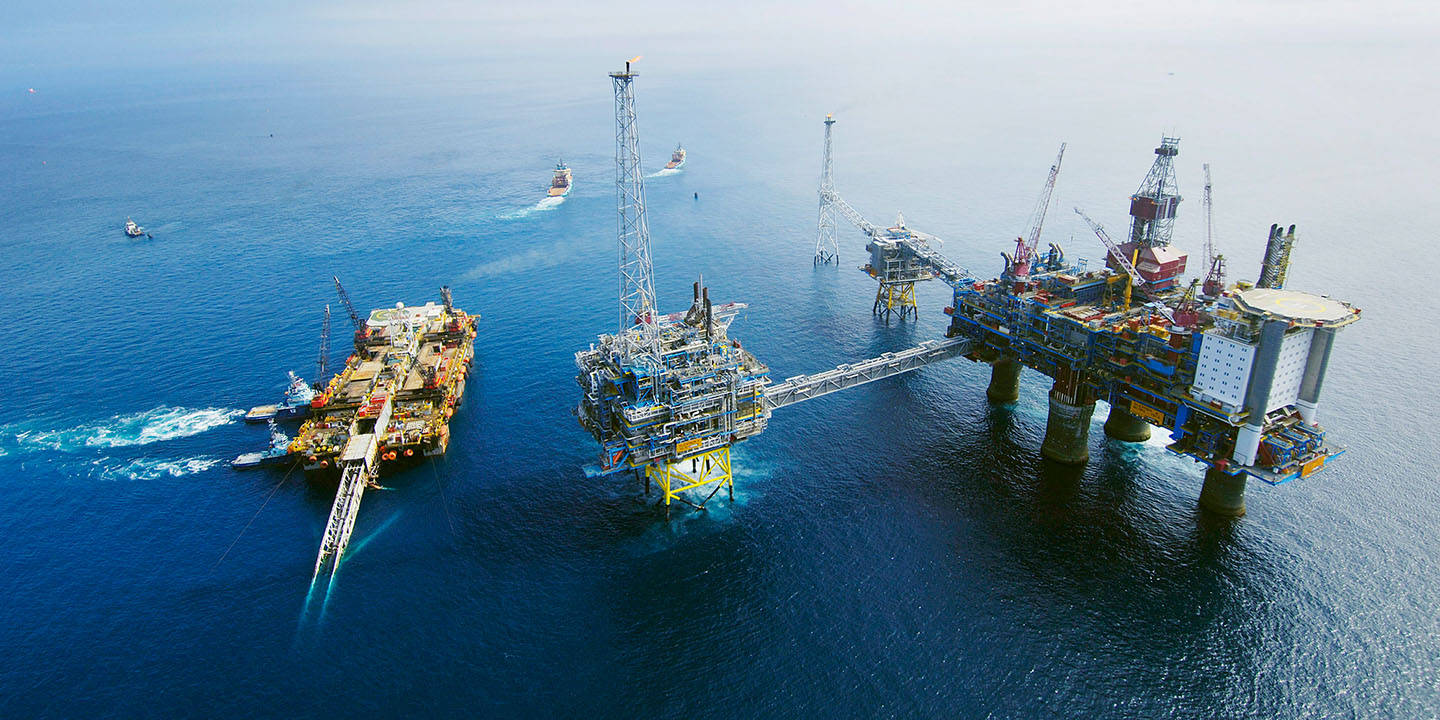
Since production started on the Norwegian continental shelf (NCS) in 1971, oil and gas have been produced from a total of 129 fields. At the end of 2025, 97 fields were in production: 69 in the North Sea, 25 in the Norwegian Sea and 3 in the Barents Sea.
Historical and expected production in Norway, 1970-2030
Updated: 20.02.2026
Source: Norwegian Offshore Directorate
Print illustration Download data Historical and expected production in Norway, 1970-2030 Download PDF Download as image (PNG)
High Contrast Mode
Overall production was 239.2 million standard cubic metres of oil equivalents (Sm³ o.e.) in 2025. Measured in oil equivalents (Sm³ o.e.), gas accounted for more than half of total production in 2025, and the forecasts indicate that the gas share will remain high going forward.
Over the next few years, total production on the NCS is expected to remain relatively stable. See the article on production forecasts for more detailed information. Declining production from mature fields will to a large extent be offset by production from new fields coming on stream. In the longer term, the number and size of new discoveries will be decisive for the production level.
The activity level in the producing fields will remain high in the years ahead, and these fields will account for the bulk of production in the coming years. Moreover, the resource base for existing facilities increases when small, neighbouring discoveries are tied-in to the existing infrastructure.
On many fields, it is possible to recover more resources than assumed in current plans. Therefore, the licensees are continuously working on new measures to increase recovery from existing fields while at the same time improving operational efficiency. An important part of this work is to tie in both new and existing commercially viable discoveries to existing infrastructure, thereby ensuring that capacity in mature areas is utilised as efficiently as possible. See resource management in mature areas for more detailed information.
Production history and forecast distributed per resource category, 2020-2035
Updated: 12.05.2026
Source: Norwegian Offshore Directorate (Gas is normalised at 40 MJ)
Print illustration Download data Production history and forecast distributed per resource category, 2020-2035 Download PDF Download as image (PNG)
High Contrast Mode
Three new fields came into production in 2025: Halten Øst and Verdande in the Norwegian Sea and Johan Castberg in the Barents Sea. Several development projects on exciting fields also came on stream, including Balder Future (as part of the Balder field), Maria phase 2 (as part of the Maria field) and Ormen Lange phase 3 (as part of the Ormen Lange field). In addition, a project related to an alternative export solution was also completed on the Gina Krog field.
At year-end, 91 discoveries were, or could be, considered for development. For most discoveries in the portfolio, tie-in to existing infrastructure represents the most likely development solution. The largest discoveries are often planned as standalone field developments, while smaller discoveries may also contribute to establish new infrastructure, for example through collaborated developments.
In 2025, the authorities approved a development and operation plan (PDO) for Fram, the southern part of the Fram Field, Fram Sør.
The table below shows the estimated reserves in fields under development. Please note that the table is continuously updated.
Reserves in fields under development
All volumes in million Sm³ o.e.
Source: Norwegian Offshore Directorate
Print table Download data Reserves in fields under development
At the year-end of 2025, 19 development projects were ongoing on the NCS. Two of these, Yggdrasil (Hugin, Munin og Fulla) and Valhall/Fenris are coordinated developments involving several fields. Among the ongoing projects, 12 are new field developments, while 7 are amendments to existing fields (related to increased recovery, changes to power supply or development of additional resources to existing fields). The interactive map below shows ongoing development projects. Investments are estimates from the PDO. Note that the map is only updated at year-end and that the geographical locations may be imprecise. However, the table above is updated continuously, and discrepancies may therefore occur between the list shown with the map and the table.
Investments in the petroleum sector in 2025 were approximately NOK 243 billion (fixed 2026 prices). Many ongoing projects, both related to new field developments and to fields in operation, contribute to an decreasing activity level in 2026.
See article about investments and costs for more detailed information.
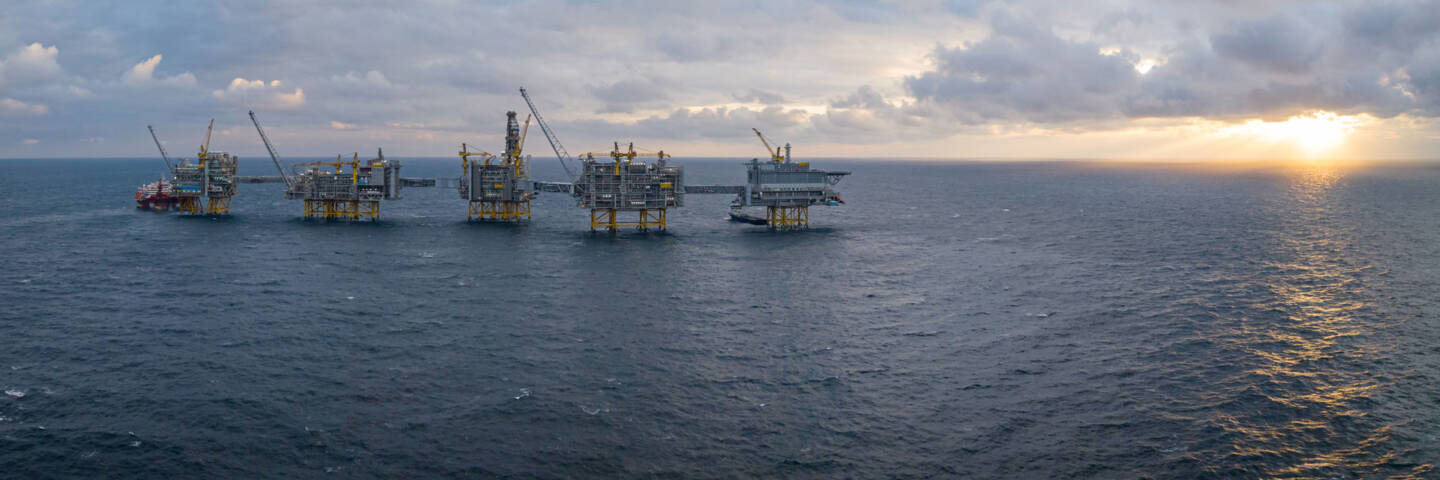
Photo: Lizette Bertelsen/Jonny Engelsvoll / Equinor
Activity levels on the Norwegian continental shelf are expected to remain high in the coming years, although uncertainty increases further ahead. Investments and activity levels are influenced by factors such as oil and gas prices, demand, regulatory conditions, and cost levels. On producing fields, drilling of new productions wells, modifications and projects related to increased recovery will contribute to activity level, but the scale depends on project profitability and capacity in the supplier industry. Several fields are under development, and additional projects may be sanctioned if discoveries are commercially viable and feasible to develop.
Exploration activity is expected to remain relatively high, although levels may vary with price expectations, access to capital and rig availability. Most exploration is carried out in mature areas where discoveries can be tied into existing infrastructure. Over the longer term, sustained exploration activity depends on the discovery of new resources that can be developed.